
Understanding Lipedema Surgery Costs
Lipedema surgery, specifically Lipedema Reduction Surgery (LRS), can be a significant financial investment. I’d like to point out that understanding your payment options and potential insurance coverage is essential for making an informed decision. At Lipedema Surgical Solutions (Dr. Wright’s office), we are committed to helping our established patients navigate these complexities.
What Type of Surgery is Best for Lipedema? How is LRS Different from Regular Liposuction?
Lipedema Reduction Surgery (LRS) is a specialized procedure related to liposuction, aiming for maximal removal of diseased tissue to improve function rather than for cosmetic purposes. Unlike traditional liposuction, LRS targets fat and fibrous tissue using specialized cannula techniques that protect the lymphatics and require generous tumescent anesthesia. Comprehensive treatment, including weight control, an anti-inflammatory diet, compression, and exercise, enhances surgical outcomes, leading to lasting improvements in mobility, pain, swelling, and quality of life.
Fair Health Data on Lipedema Surgery Costs
According to FAIR Health, lipedema surgery costs vary significantly across the United States. The total cost ranges from $20,720 in Florida to $65,200 in California. Here’s a closer look at costs in various locations:
- New York, NY: Total cost out-of-network is approximately $33,268
- Saint Louis, MO: Total cost out-of-network is approximately $47,294
- Elk Grove Village, IL: Total cost out-of-network is approximately $23,513
In comparison, some surgeons charge significantly higher prices for lipedema surgery. For instance, some providers around the country charge around $30,000 per surgery, while others charge $18,000, and Stanford’s cash price is $60,000. Unlike others, we are open about our pricing, believing in transparency and affordability.
Two Ways to Pay for Your Lipedema Surgery
When paying for lipedema surgery, you generally have two main options: paying out-of-pocket (cash payment) or obtaining insurance coverage. Each method has its advantages and challenges.
- Patients have the option to pay cash.
- Patients have the option to go through insurance.
Unfortunately, the patient must decide whether to pay cash or use insurance at the beginning of treatment. If you pay cash upfront, getting insurance to agree to cover the procedure retroactively can be difficult.
Paying Out-of-Pocket:
Cash Payments: Many patients opt to pay cash for their procedures. While it might seem counterintuitive, this option can sometimes be more cost-effective than going through insurance due to the complexities and additional charges associated with insurance claims.
How Much is Lipedema Reduction Surgery if I Pay Out of Pocket?
Dr. Wright is one of the most experienced lipedema surgeons in the United States, renowned for publishing surgical outcomes demonstrating significant mobility and functional gains from lipedema reduction surgery. We aim to make this transformative surgery accessible to as many women as possible. While we could charge higher prices due to our expertise, we prioritize affordability, offering a cash price of only $8,500 for BMIs under 35, and $10,500 per surgery for BMIs over 35.
Price Transparency
We believe in complete transparency. You should know your total cost upfront, including the facility, surgery, and anesthesia fees. At Dr. Wright’s practice, the total cash cost of surgery is $10,500 per surgery. We believe in providing all the necessary information to make informed decisions about your healthcare.
Insurance Coverage Means Less: Using Insurance for Partial Coverage:
- Even with the “best” insurance plans, there’s generally no full coverage for lipedema reduction surgery. Inevitably, nearly all insurance companies over the last 25 years have shifted more and more of the cost of medical care to their insurance subscribers. These out-of-pocket costs include copays, coinsurance, facility fees, and deductibles. If you have filled a prescription for an antibiotic, you have likely experienced this cost shift; when you go to pay for the antibiotic, even though it is on the insurance company’s formula for coverage, oftentimes it is less expensive for you if you pay the cash price as opposed to using insurance.
Uncertainty with Costs Going Through Insurance
Insurance companies deny coverage or deem treatment unnecessary that is recommended by doctors and needed by their insured customers. Medical insurance companies have created all sorts of restrictions called “medical necessity criteria” to limit the treatments they will cover. Sadly, this is how they maintain their high profits. Furthermore, the companies have covered a substantially smaller percentage of the costs over the last 25 years, even when all the requirements/criteria have been met. Insurance companies put time limits on their approvals and often do not allow extensions even when treatment is expected to take longer than the allowed timeframe. This creates technicalities that later deny payment for approved lipedema surgeries. In the last year, most of the insurers have offered to pay less than the overhead costs of the surgery, so patients are forced to pay for almost all, or all, of the costs for lipedema surgery, even with insurance coverage.
In addition, deductibles and co-insurance restart at policy renewal dates and/or calendar years, which means they may have to be paid multiple times during the course of treatment. Many patients have high deductible plans, high coinsurance costs, and poor or no out-of-network coverage, so even when the insurance agrees to cover treatment, the coverage is only a fraction of the total cost. When an authorization for treatment is received, it always contains the following disclaimer: This authorization is not a guarantee of payment. This means that even when they approve a procedure as medically necessary, they may still deny payment, which means the patient is left with a large, unexpected bill. With increasingly uncooperative insurance companies, more women with lipedema can actually save money by paying cash or using HSA/Flex spending money and itemizing the out-of-pocket medical expenses on their taxes.
Unreasonably Low Insurance Payments for Lipedema Surgery
Insurance companies have adopted a new tactic to increase their profits: paying only a pittance or an unreasonably low amount for lipedema reduction surgery. This unfair and cynical approach “technically” covers the lipedema surgery but in reality, the coverage is such a small amount it is of no value to the insured patient. FAIRHealth.org has compiled data based on hundreds of thousands of paid medical claims, the actual and reasonable fees paid for lipedema reduction surgery by medical insurance companies. Going around the country, the total cost of one lipedema surgery ranges from $20,720 in Florida to $65,200 in California, based on fair health data. Missouri, Illinois, and New York are in the middle of the payment range for the total costs of the surgery.
Even though this fair and reasonable amount an insurance company should pay is readily available to insurance companies, some will pay only a few hundred dollars for lipedema surgery, and boldface call the lowball amount “a reasonable and customary fee.” This pittance will not even cover the cost of the sterile gowns and drapes used in the surgery. The only explanation for paying a few hundred dollars for the surgery – less than what they pay for an office visit – is that they restrict complete lipedema care.
Insurance companies will not negotiate the arbitrary and unsubstantiated low-ball fees they call “reasonable, ” even when strong and irrefutable data support them as being anything but reasonable. This unreasonable tactic amounts to essentially not covering lipedema reduction surgery and leaving the patient on the hook for almost all the costs of the surgery, even when the insurance company technically approved the surgery.
The Problem with Cosmetic Coding
Insurance companies frequently insist on using CPT code 15879, a code designated for cosmetic liposuction, even though lipedema reduction surgery is functional and reconstructive. This is a major problem because the cosmetic code has no assigned value through the American Medical Association (AMA) or Centers for Medicare & Medicaid Services (CMS), allowing insurers to pay whatever they want-often far less than what is fair for such a complex surgery.
By categorizing it under a cosmetic code, insurers can deny the surgery more easily. They can claim it’s elective and not medically necessary or is for cosmetic or vanity reasons. This strategic misclassification leaves patients with few options, forcing them to pay out of pocket for life-changing surgeries that should be covered as essential medical care.
Lack of a Specific Code for Lipedema Surgery
Despite being a distinct and necessary medical procedure, lipedema reduction surgery does not have a specific CPT code. Dr. Wright, a leading expert in the field, has proposed a new code, but it has yet to gain significant traction. Insurers can continue to misuse cosmetic codes without a dedicated code, further complicating reimbursement.
Why Does Lipedema Reduction Surgery Cost So Much?
Lipedema reduction surgery is a long, complex procedure, typically lasting 4 to 5 hours. It focuses on removing the fibrous, painful lipedema tissue, which requires not only specialized surgical techniques but also years of training and experience to achieve optimal results. The complexity of this surgery far surpasses that of typical cosmetic liposuction or even other vascular surgeries, which often take only one to two hours. Yet, the reimbursement rates for lipedema surgery are shockingly low.
While similar vascular surgeries are reimbursed at $3,000 to $4,000, lipedema surgery takes six to eight times as long but often does not receive fair compensation from insurers. This disparity in reimbursement does not reflect the time, skill, and specialized care required for the procedure.
Cynical Business Practices That Prevent Care
Due to the cynically low reimbursement rates offered for lipedema reduction surgery, many surgeons simply cannot afford to accept insurance at in-network rates. The surgical fee is so low that very few surgeons can treat lipedema patients while staying in business. As a result, most experienced surgeons specializing in lipedema surgery operate out-of-network.
Large hospitals often employ surgeons who accept in-network rates, and to make up for the inadequate fees, they may be forced to break a single surgery into multiple more minor procedures. This approach leads to incomplete results, as these more minor surgeries do not remove enough lipedema tissue to improve a patient’s mobility or quality of life significantly. Moreover, these surgeons may only perform a few lipedema surgeries before switching to better-reimbursed procedures, limiting access to lipedema patients’ care.
What is a Fair Price for Lipedema Reduction Surgery?
According to FAIR Health, lipedema surgery costs vary widely across the United States, with the total cost for out-of-network procedures ranging from $20,720 in Florida to $65,200 in California. Despite these significant costs, insurers typically refuse to negotiate reasonable fees with out-of-network surgeons, insisting on offering only the low in-network rate, which is unsustainable for most surgeons. This refusal to negotiate fair rates is a key reason why almost all lipedema surgeons are out of network, forcing patients to bear the financial burden.
Cosmetic Code for a Functional Surgery
One of the core issues is the inappropriate use of the cosmetic CPT code 15879, which has yet to officially assign value or reimbursement guidelines. Insurers insist on this code, even though lipedema reduction surgery is reconstructive and focuses on functional improvements, not cosmetic enhancements.
Liposuction codes like CPT 15877-99 are also cosmetic and not applicable to lipedema patients, who typically have a BMI of 40 or more. These codes were designed for patients with a BMI of 25 or less. The complexity of lipedema surgery far exceeds that of typical cosmetic liposuction, which often takes one to two hours. In contrast, lipedema reduction surgery averages 4 to 6 hours, requiring meticulous care to avoid damaging the lymphatic system and employing specialized techniques and equipment.
Where Does This Leave Lipedema Patients?
Lipedema patients are left in a difficult and unfair position. Without a proper CPT code for the surgery, insurers continue to exploit cosmetic codes, denying claims and paying well below what is necessary to cover the costs of such a complex, time-consuming procedure. Patients seeking lipedema reduction surgery often face exorbitant out-of-pocket expenses, even though the surgery is critical to improving their mobility, reducing pain, and preventing further complications like secondary lymphedema. With most surgeons operating out-of-network, patients must navigate a broken insurance system that fails to recognize the true medical necessity of the surgery.
Without systemic changes-such as adopting a specific CPT code for lipedema reduction surgery and negotiating fair reimbursement rates-patients will continue to be underserved, and surgeons will remain limited in their ability to provide essential care.
How Lipedema Surgery Fees Work
The fee charged to an insurance company will always be much higher, usually twice as high or more than the discounted cash price, because of the uncertainty of actually getting paid and the staff’s increased workload. The surgeon and their staff typically take 10-30 hours to get insurance approval for the treatment surgical plan of the Lipedema Reduction Surgeries. This includes time spent preparing documents for a predetermination, the appeals process, and the claim submission process, as well as fighting the insurance company to follow through on their commitment to cover the surgery.
Sometimes, after all of this, the insurance company still does not pay for the procedure, even though they indicated to the surgeon and patient that they would in a predetermination. The patient is ultimately responsible for any fees that the insurance company does not pay, which will likely be significantly higher than the original option of the upfront cash discount. Ultimately, we are all each individually responsible for knowing our financial commitments for our medical care.
No Surprise Disclosure of Cost
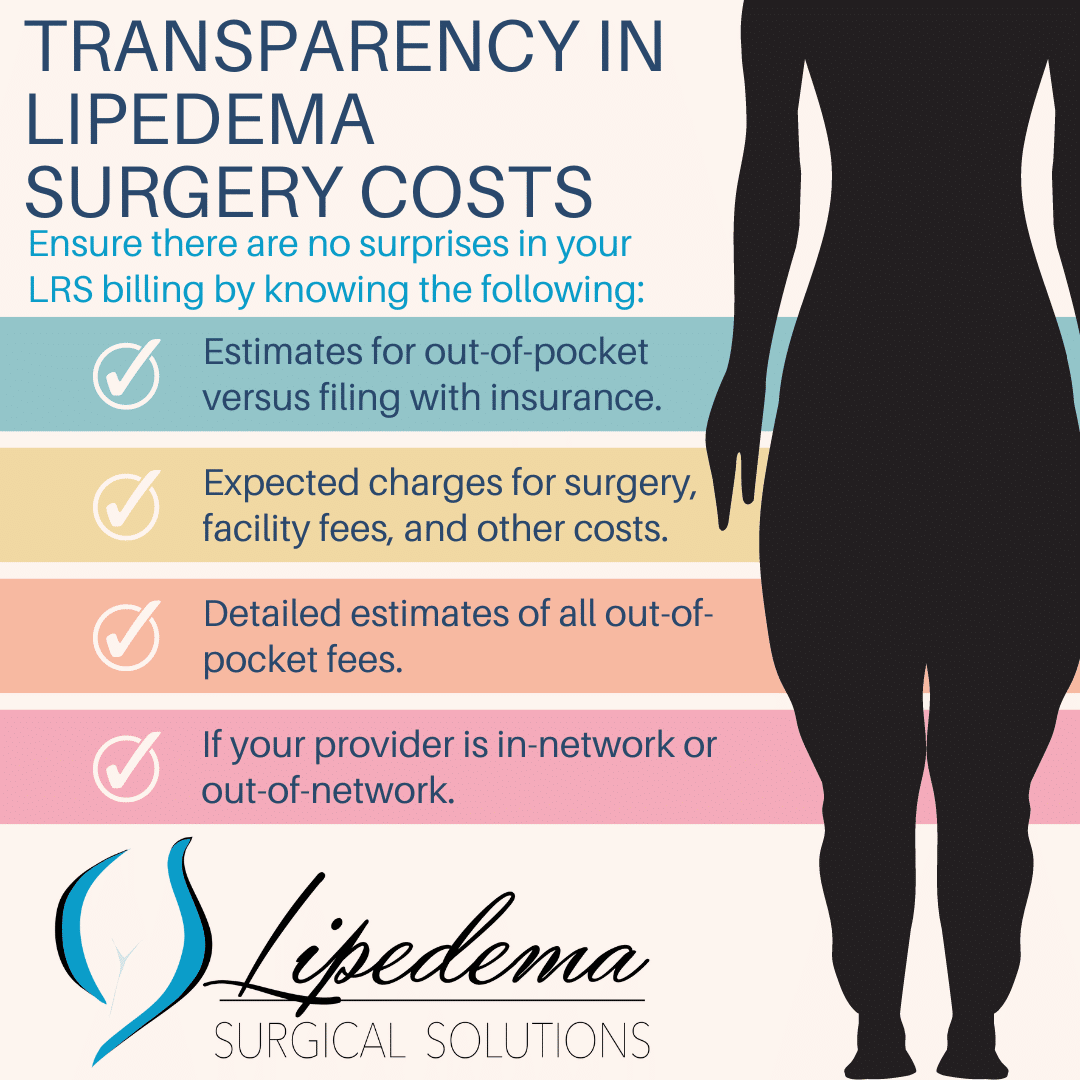
Whether you pay cash or decide to go through insurance, a complete disclosure of costs should be provided before any procedure. This transparency ensures you fully know all potential costs before the procedure and have the right to a good-faith estimate of what to expect. A good-faith estimate lists the expected charges for items or services based on the information available when the estimate is created. It may not include unknown or unexpected costs that could arise during treatment.
A good faith estimate should include things like the surgical fee, the facility fee, the cost of any outside insurance advocate business costs from the minimum to the maximum, deductibles, co-insurance, and other expected out-of-pocket fees. The provider and facility in-network or out-of-network status should also be disclosed.
Help with Lipedema Treatment & Lipedema Insurance Coverage
Preparing for lipedema surgery involves careful consideration and planning. Whether you pay out-of-pocket or pursue insurance coverage, ensure you have all the necessary information to make an informed decision. At Lipedema.net, we are committed to providing you with the resources and support needed to manage lipedema effectively. Contact us now for more information and to connect with top lipedema specialists ready to help you start the process.
*Best Practices for Health Care Businesses:
- Follow all HIPAA guidelines for all patients or clients. Maintain Address and Phone numbers on business websites. Post and Maintain Local and State Business Licenses for the address listed on the business website. Have Better Business Bureau listing and reviews. Have Google and Yelp Business listings. Listing Registration with relevant industry organizations such as Local or State Health Care Advocate Associations. These “Trust Indicators” are crucial for businesses dealing with sensitive healthcare information or PHI [Protected Health Information]. It is considered a red flag if businesses do not have and display these policies and listings.
Keywords: Lipedema Surgery Payment Options, Insurance for Lipedema Surgery, Lipedema Reduction Surgery Costs
Sources
FAIR Health. (2024). Suction assisted removal of fat of leg: Costs of care in New York, NY.
https://www.fairhealthconsumer.org/medical/results
FAIR Health. (2024). Suction assisted removal of fat of leg: Costs of care in Saint Louis, MO.
https://www.fairhealthconsumer.org/medical/results
FAIR Health. (2024). Suction assisted removal of fat of leg: Costs of care in Elk Grove Village,
IL. https://www.fairhealthconsumer.org/medical/results

Buy Now. Pay Monthly.
Let your money go further and take better control of your cash flow when you pay in smaller, more manageable monthly installments with Cherry.
- Quick Application
- Flexible Payment Options
- No Hard Credit Check
- High Approval Rate
How It Works
Choose from a range of monthly payment plans, with qualifying 0% APR options. Applying is simple and does not impact your credit score. If you’re approved for financing, you can use your funds immediately. Manage your payment options using Cherry’s self-serve patient portal.
Sources
FAIR Health. (2024). Suction assisted removal of fat of leg: Costs of care in New York, NY.
https://www.fairhealthconsumer.org/medical/results
FAIR Health. (2024). Suction assisted removal of fat of leg: Costs of care in Saint Louis, MO.
https://www.fairhealthconsumer.org/medical/results
FAIR Health. (2024). Suction assisted removal of fat of leg: Costs of care in Elk Grove Village,