
If you’ve been living with lipedema, dealing with painful, heavy legs that don’t respond to diet or exercise, you may be wondering whether surgery is right for you. It’s a big question, and it deserves a thorough answer.
Dr. Thomas Wright, MD, FAVLS, RVT, has been treating patients with lipedema for over 20 years at Laser Lipo and Vein Center in St. Louis and O’Fallon, Missouri. He recently sat down with Vein Health News for an in-depth Q&A on lipedema surgery, what it involves, who it’s right for, and what patients can realistically expect.
About Dr. Wright: Dr. Thomas Wright is the medical director of Laser Lipo and Vein Center, serving patients across Missouri and the Midwest. He has published outcomes data on lipedema surgery, maintains a very low complication rate, and is affiliated with the National Lymphedema Network and AVLS Congress. He ranks in the top 10% among physician peers for research citation and impact, according to Doximity.
Why Do Patients With Lipedema Seek Surgical Treatment?
The most straightforward reason is this: their symptoms are not fully managed with conservative treatments alone. When daily pain, swelling, mobility limitations, and reduced quality of life persist despite diet, compression, and other therapies, surgery becomes an appropriate next step.
Lipedema reduction surgery, a modified form of liposuction, removes the bulk of lipedema tissue from the affected areas. This can lead to meaningful improvements in how patients move, how they feel, and how they live. Reducing bulk tissue can improve joint mechanics and knee function, allowing patients to walk more freely and participate in daily activities with less pain.
The evidence is compelling. The LIPLEG study, a landmark randomized controlled trial, found that more than 70% of women who underwent lipedema liposuction had significant improvement in pain and quality of life, compared to only 10% in the conservative treatment group (1). The study showed a 26:1 odds ratio of significant improvement for those who had surgery. Those numbers reflect what Dr. Wright sees in his own patients every day.
What Steps Should Patients Take Before Surgery?
Dr. Wright is clear that surgery works best when patients are already managing their lipedema comprehensively. Before moving forward with surgery, he recommends:
- Following an anti-inflammatory diet that limits refined carbohydrates
- Addressing secondary obesity if present
- Wearing medical-grade compression garments daily, this is non-negotiable
- Seeking treatment for any significant varicose veins, which can increase bleeding risk during surgery
Compression deserves particular emphasis. Dr. Wright explains that medical-grade compression is critical for “priming the lymphatics” before surgery and for helping the skin reset into its new position post-operatively. Patients who can tolerate consistent compression tend to have better surgical outcomes.
These conservative steps are essential to making sure the body is in the best possible condition before surgery, and that the lifestyle changes needed to maintain results are already in place. Surgery is not a cure, and lifelong adherence to diet, compression, and weight maintenance is necessary to protect the results long-term.
Is Surgery Right for Everyone With Lipedema?
Who is a good candidate?
The vast majority of women with lipedema who are in overall good health are candidates for surgery, provided their symptoms are not adequately controlled through diet and compression alone.
Surgery is effective across a range of patients:
- Smaller patients with early-stage lipedema may see significant pain reduction, swelling relief, and potentially halted disease progression, along with cosmetic improvement in many cases
- Patients with more advanced lipedema often experience the most dramatic improvements in mobility and quality of life
For patients at every stage, the primary goal of surgery is pain relief and reduction of swelling. Cosmetic results vary depending on disease stage, and Dr. Wright sets clear, realistic expectations with each patient from the start.
Are there patients Dr. Wright would advise against surgery?
Yes. Surgery carries risks, and for some patients those risks outweigh the likely benefits. Dr. Wright does not recommend surgery for patients with:
- Active coronary artery disease or other significant heart conditions
- Insulin-dependent diabetes, due to increased surgical complication risks
- Very early Stage 1 lipedema with few or no symptoms, conservative management is often sufficient in these cases
For patients in these categories, Dr. Wright focuses on comprehensive conservative management to support the best possible quality of life without surgical intervention.
What Surgical Techniques Are Used for Lipedema?
The three most studied and proven techniques for lipedema reduction surgery are:
- Tumescent liposuction, the foundational approach that all three techniques build on
- Water-assisted liposuction, the tumescent solution is delivered with additional pressure to further prepare the tissue
- Power-assisted liposuction, uses a vibrating cannula to assist in the gentle removal of lipedema tissue
All three rely on the tumescent method, in which a solution of dilute local anesthetic, epinephrine (to minimize bleeding), and saline (to protect surrounding tissue) is infused into the treatment area before fat is removed.
An important note: Dr. Wright takes extra care to protect the lymphatic system during surgery. Because women with lipedema already have elevated risk for lymphatic impairment, he follows specific techniques designed to minimize the risk of damaging lymphatic collectors, incorporating the published work of Frick and Baumgartner on lymphatic-preserving liposuction. As Dr. Wright puts it: “If I prevent even one case of lymphatic injury, I am happy to take the precautions.”
How Many Surgeries Are Typically Needed?
Lipedema often affects multiple areas of the body, and surgery is typically staged across several procedures. Dr. Wright’s general framework:
- Leg treatment: usually one but up to three surgeries depending on the patient. Many patients just do leg surgeries.
- Arm treatment (if involved): typically one surgery
- Trunk treatment (if involved): one additional surgery
- Total: from one to five total surgeries for patients, depending on how widespread the involvement
The number of procedures depends on disease stage, the areas affected, and the volume of tissue involved. Smaller patients may require fewer surgeries. Dr. Wright builds a personalized surgical plan with each patient that is realistic, safe, and prioritizes the areas of greatest functional impact first.
What Does Recovery Look Like?
Post-operative care is straightforward but requires commitment. The most critical elements are:
- Wearing compression garments consistently, without folds or creases, from the very beginning
- Expecting some post-operative drainage for one to two weeks
- Most patients return to light activity and work within three to seven days
Compression after surgery serves the same purpose it does before: it helps the skin adapt to its new position and supports healthy lymphatic function. Patients who are diligent with their compression tend to heal more smoothly and see better long-term results.
Is Lipedema Surgery a Cure?
No, and Dr. Wright is direct about this. Surgery reduces lipedema tissue; it does not eliminate the underlying condition. Some fat tissue will remain, and the disease can progress if lifestyle changes are not maintained.
For surgery to have lasting results, patients must continue:
- Following an anti-inflammatory diet
- Wearing compression regularly
- Maintaining a stable weight
- Staying physically active in ways their body tolerates
That said, Dr. Wright does not believe surgery should be treated as a “last resort”, something withheld until a patient has reached a crisis point. For women whose symptoms are not controlled by conservative means, surgery can substantially improve quality of life, and delaying it until complications develop is not in the patient’s best interest.
How Do You Find the Right Surgeon?
This is one of the most important questions a patient can ask. The number of surgeons offering lipedema liposuction has grown in recent years, but deep, disease-specific experience matters enormously. A surgeon who performs standard cosmetic liposuction without specialized lipedema knowledge may not achieve the same results, and in some cases may cause harm.
When evaluating a lipedema surgeon, patients should ask:
- How many lipedema cases have you treated?
- Are you familiar with lymphatic-preserving surgical techniques?
- Do you take a comprehensive approach including pre- and post-operative compression?
- Can you share your outcomes data or complication rate?
- Do you coordinate care with lymphedema therapists and other specialists?
Dr. Wright has treated lipedema patients for over 20 years, has published his surgical outcomes, and maintains one of the lowest complication rates in the field. He provides a full continuum of care, from diagnosis through surgery and long-term management, at his St. Louis and O’Fallon offices.
What About the Emotional Side of Lipedema?
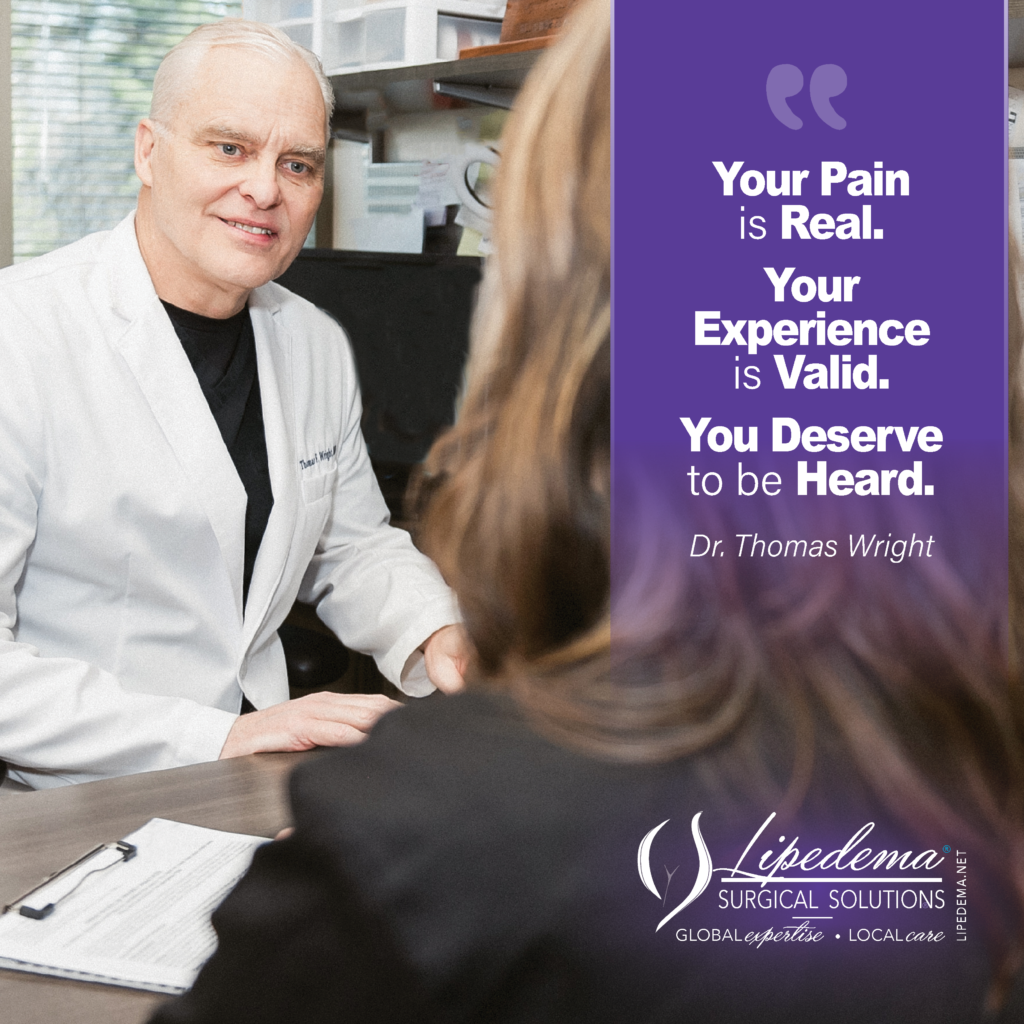
Dr. Wright acknowledges that the emotional burden of lipedema is real and significant. Many of his patients have spent years, sometimes decades, being dismissed by providers, told to lose weight, and made to feel personally responsible for a condition they did not cause.
Research confirms that depression, anxiety, and other mental health challenges are more common among people with lipedema. While emotional support needs vary by individual, Dr. Wright recognizes that addressing mental health is an important part of comprehensive lipedema care.
Counseling, peer support groups, and online communities can all play a meaningful role in helping patients process their diagnosis, carry the weight of a chronic condition, and build the resilience needed to sustain long-term lifestyle changes.
Read the Full Q&A
Dr. Wright’s complete interview, along with a comprehensive clinical overview of lipedema diagnosis, staging, and management, is featured in the current issue of Vein Health News. Written for healthcare providers but freely available to the public, it is one of the most thorough overviews of lipedema available anywhere. We encourage patients, family members, and referring providers to read it.
Ready to Talk to a Lipedema Specialist in St. Louis or O’Fallon?
You don’t have to keep living with pain, swelling, and unanswered questions. Dr. Thomas Wright and the team at Laser Lipo and Vein Center are here to listen, evaluate your situation, and walk you through every option available, from conservative management to surgical intervention.
We serve patients throughout Missouri, including St. Louis, O’Fallon, and the surrounding region. Many patients also travel from across the Midwest for Dr. Wright’s specialized care.
Contact us today to schedule a lipedema consultation. You deserve real answers, and real relief.
Sources
- Herbst KL, Kahn LA, Iker E, et al. Standard of care for lipedema in the United States. Phlebology. 2021;36(10):779-796. Vein Health News, Volume 10 Issue 1. veinhealthnews.com LIPLEG Study: lipedema.net/groundbreaking-lipleg-study-results-transform-lipedema-treatment-germany-leads-the-way-in-evidence-based-care/