For most of the women we care for, the hardest part of lipedema was simply about being taken seriously. There’s often years of hearing “just lose weight,” of tests that came back normal, and of pain that nobody could explain.
In September 2026, the results of the LIPLEG study, a randomized controlled trial, were published in The Lancet, one of the most respected medical journals in the world. Within weeks, the findings were covered by Medscape, a news source read by physicians across the United States and Europe, in a feature that included voices from the Lipedema World Alliance.
Lipedema is no longer a niche condition discussed in small specialty circles. It is in the top peer-reviewed journals and on the national and international medical news stage. For patients, that visibility matters as much as the results themselves.

What the LIPLEG study found
LIPLEG (short for liposuction and leg) was commissioned by Germany’s Federal Joint Committee, the body that decides what statutory health insurance covers. It is the first large, multicenter randomized trial to compare lipedema surgery directly against the standard conservative care most patients are offered.

How the study was designed
- 410 women with stage I, II, or III lipedema and leg pain of at least 4 out of 10
- 11 treatment centers across Germany
- Every participant first completed up to seven months of complex decongestive therapy, meaning compression, manual lymphatic drainage, exercise, and skin care
- Women were then randomly assigned, two to one, to lymphatic-sparing liposuction or to continued conservative therapy alone
- The main question was simple: did leg pain drop by at least two points on a 10-point scale one year later?
The design is important. Nobody skipped conservative care. Surgery was studied as the next step for women who were still in pain after doing everything else right, which is exactly how we approach lipedema treatment in Missouri.
The results
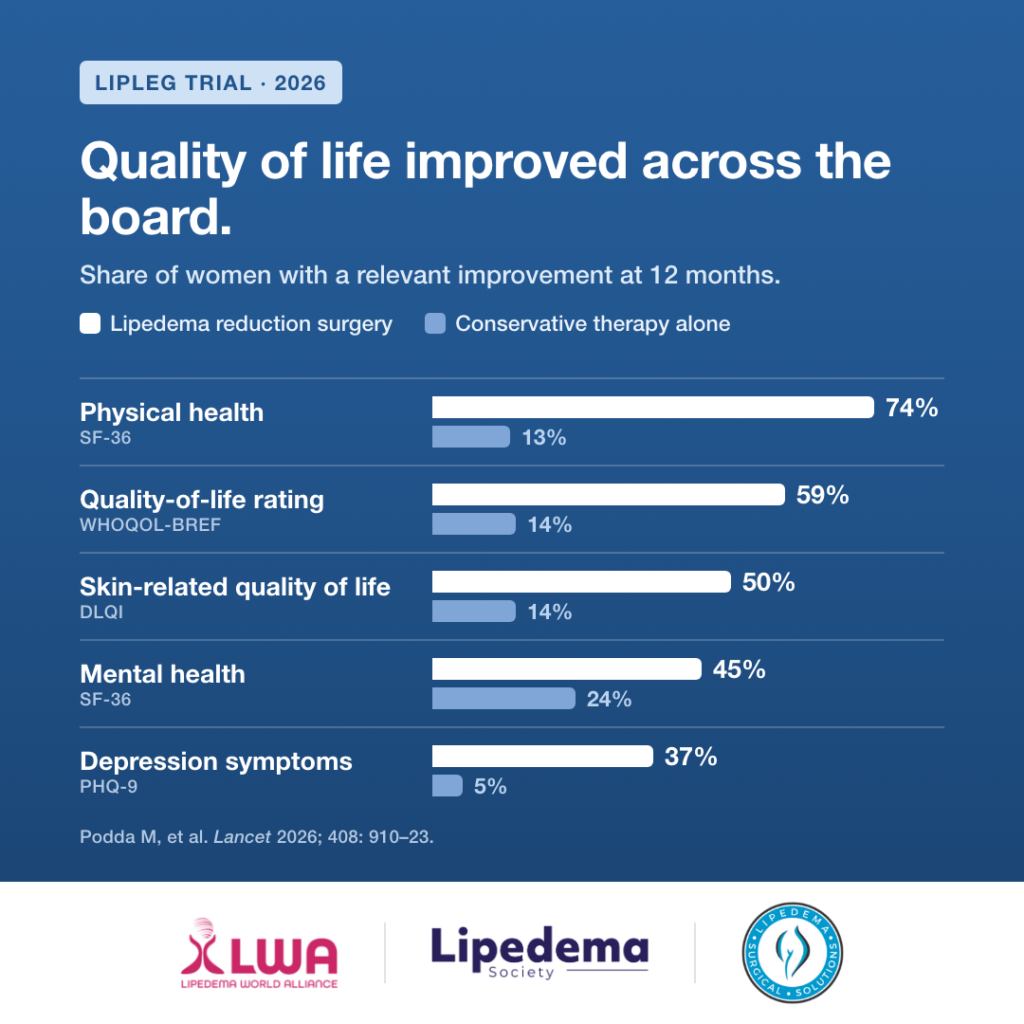
- 68% of women who had liposuction reached a meaningful reduction in leg pain, compared with 8% who stayed on conservative therapy alone
- Average pain scores fell from 6.2 to 2.6 out of 10 in the surgery group, and stayed essentially unchanged in the conservative group
- The benefit held across all three stages: 68% in stage I, 73% in stage II, and 65% in stage III
- Physical health and mobility improved substantially, and measures of mood and overall quality of life improved as well
- Easy bruising, one of the most common and least discussed lipedema symptoms, also improved after surgery
Most women needed more than one procedure. Two thirds had four liposuctions, and about 69% were still using some form of conservative therapy a year later. Surgery is not a cure and it does not replace compression. It is the one treatment that removes the diseased tissue, and the study shows it can help reduce the pain that conservative care alone often cannot touch.
What about risks?
Surgery carries more risk than compression, and the study says so plainly. Side effects of any kind were reported by 47% of the surgery group versus 21% of the conservative group. Serious events occurred in 7.5% versus 3.4%. The most common complications were a drop in hemoglobin after surgery and surgical-site infections, both of which the researchers anticipated.
Importantly, no unexpected or life-threatening events were reported. For patients weighing their options, that is the honest picture: a real but manageable surgical risk in exchange for a large and consistent improvement in daily pain.
At what cost?
The Medscape feature carried a provocative title: “Lipedema: Liposuction Cuts Pain, but at What Cost?” If you only read the headline, you might think the medical community is doubting the results. It is not.
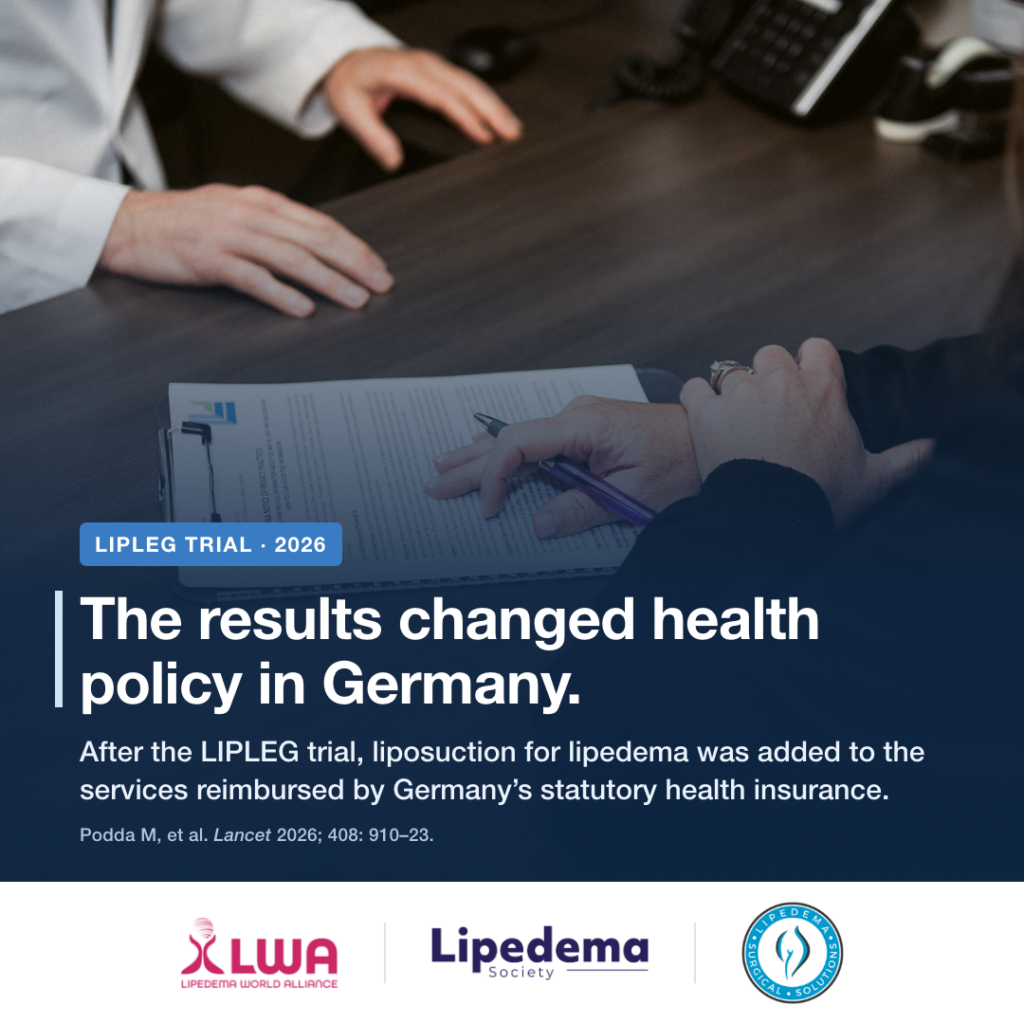
The question is about money and access, not about whether the treatment works. Based on early LIPLEG data, Germany decided in 2025 to add lipedema liposuction to the services covered by statutory health insurance, regardless of stage. That is a landmark decision. It also means a national health system now has to pay for a lot of surgeries for a condition that affects a great many women.
Experts quoted in the coverage, including Dr. Gabriele Faerber of Hamburg, a colleague of Dr. Wright’s through the Lipedema World Alliance, and Dr. Tobias Hirsch, raised concerns about how coverage is being implemented. Dr. Faerber has publicly criticized the rule limiting coverage to patients below a certain body mass index, arguing it treats lipedema as if it were obesity. Dr. Hirsch has described a gap between the policy on paper and the number of patients actually able to access surgery.
In other words, the science is settled enough to change national policy. The hard part now is making sure the women who qualify can actually get care. That conversation is just beginning, and it is one every country, including ours, will eventually have to have.
Why this is important for lipedema patients in St. Louis and O’Fallon
Dr. Thomas Wright has been treating lipedema and lymphatic disorders for more than 25 years, long before the condition had a randomized trial behind it. He is a Diplomate of the American Board of Venous and Lymphatic Medicine, among the first 200 physicians board certified in phlebology in the United States, and the author of the most-cited paper on lipedema standard of care in the United States, published in Phlebology in 2021.
He also knows the people behind LIPLEG. Dr. Wright has long modeled his practice on the lymphatic-sparing techniques pioneered by Dr. Stefan Rapprich, one of the German physicians interviewed in the Medscape coverage, and he collaborates with Dr. Faerber through the Lipedema World Alliance.
For patients, that means a few concrete things:
- The approach we use in Missouri, conservative therapy first and lymphatic-sparing reduction surgery when pain and function do not improve, is the same approach LIPLEG validated
- A clinical lipedema diagnosis, based on history and examination rather than a lab test, is the foundation of everything that follows. If you have been told your legs are “just weight,” you deserve a second look from a specialist
- Evidence published in The Lancet gives patients, and the physicians who advocate for them, a far stronger footing in conversations about care
We are careful not to promise what the research does not. Long-term results beyond 12 months are still being collected, and the LIPLEG team is following participants out to three years. But for the first time, a woman asking whether lipedema surgery can help her has a high-quality, randomized answer: for most patients who have not found relief with conservative care, it can.
A moment worth celebrating
Patient advocacy made this study possible. German patients asked for the trial, waited years for it, and participated in it. Organizations like the Lipedema World Alliance, the Lipedema Society, and Legs Like Mine have spent years pushing lipedema from a dismissed diagnosis toward a recognized chronic disease. LIPLEG is proof that persistence works.
If you have been living with painful, swollen legs that do not respond to diet or exercise, and you are wondering whether you have lipedema, you do not have to keep wondering.
Schedule a lipedema consultation with Dr. Wright at Lipedema Surgical Solutions in O’Fallon to find out whether you have lipedema and which treatment options are right for you.
Read our full breakdown of the LIPLEG study, including the stage-by-stage results and study design graphics, here.